The Open Door: Hospitality and the Guest in Heathen Tradition
Of all the old virtues, hospitality may be the one our ancestors took most seriously. In a world of long winters, rough roads, and scattered farms, a closed door could mean death for a traveler. So the duty to welcome a guest was not just good manners. It was sacred.
The Guest’s Section of the Hávamál
The Hávamál, the “Sayings of the High One,” opens with what scholars call the Gestaþáttr, the guest’s section. Before it gives any advice on wisdom, war, or love, it talks about the man at the door.
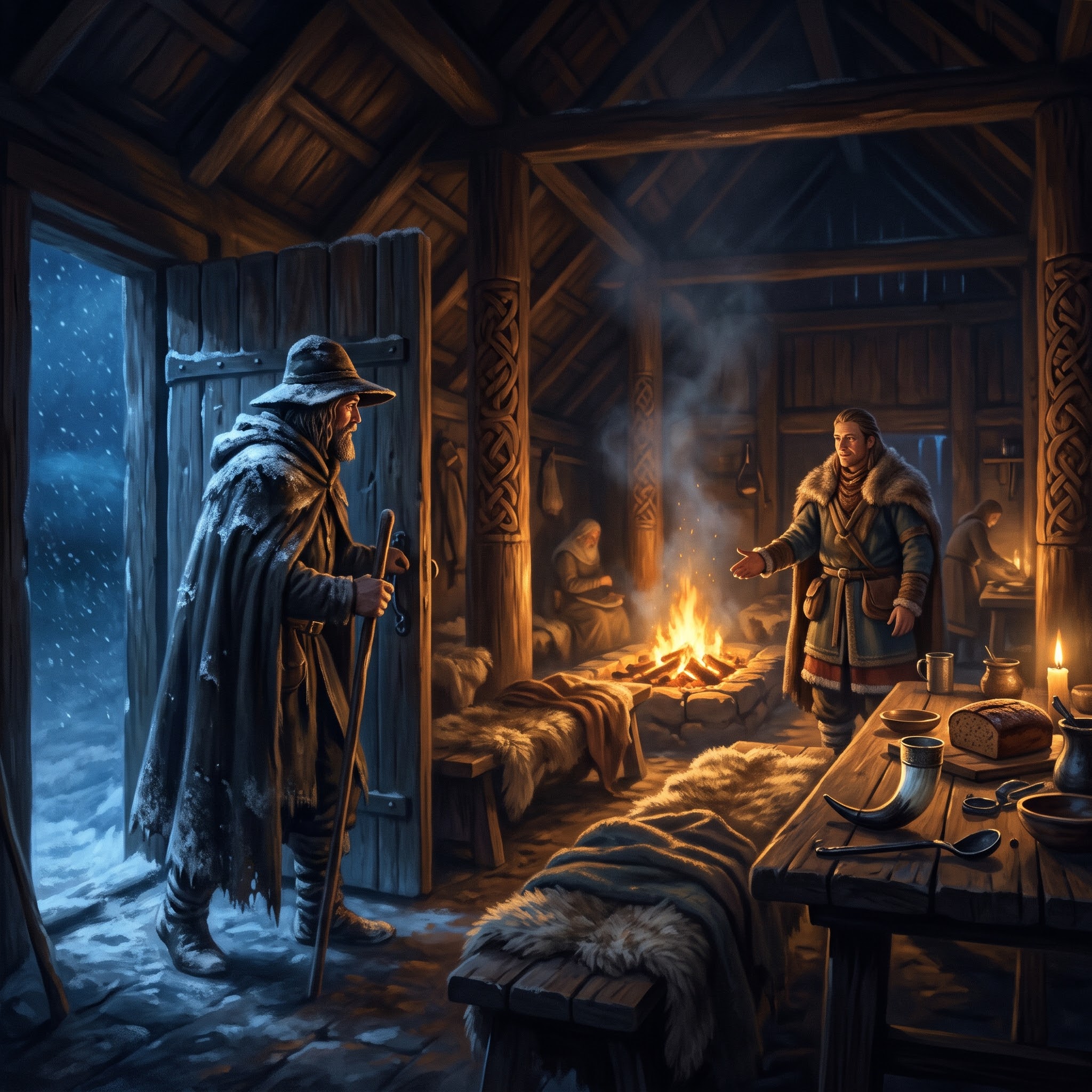
The first verses tell the traveler to look carefully around every doorway before he walks in, because you never know who is sitting inside. Then the poem turns to the host. It blesses the giver and asks where the guest should sit. It says a man who comes in from the cold with numb knees needs fire. He needs food and dry clothes after crossing the mountains. He needs water, a towel, and a friendly welcome, and a chance to speak and be heard.
That is a simple list, and that is the point. Warmth, food, water, a seat, and respect. Nothing fancy. Just the basics a person needs to feel human again after a hard road.
Later in the same poem, the advice given to Loddfáfnir comes back to it. Do not mock a guest. Do not drive a stranger from your gate. Treat the poor and the weary well. The High One clearly thought this was worth saying more than once.
The Story of Grímnir
The lore also shows us what happens when the law of the guest is broken. In the Grímnismál, Odin comes to the hall of King Geirröd wearing a dark cloak and calling himself Grímnir. The king does not know who he is and treats him as a threat. He has the stranger seized and set between two fires, and leaves him there for eight nights without food or drink.
Only one person shows him kindness. Agnar, the king’s young son, brings the stranger a full horn to drink and says his father is wrong to treat a guest this way.
As the fire burns closer, Grímnir begins to speak. He tells of the halls of the gods, the world tree, and the order of the worlds. At the end he reveals who he really is. Geirröd jumps up to free him, stumbles, and falls on his own sword. Agnar, the boy who shared his drink, becomes king.
The message is hard to miss. You never know who is standing at your door. The way you treat a stranger says everything about who you are, and the gods are watching.
Why It Still Matters
Most of us are not crossing mountains on foot anymore. But the heart of this teaching still fits. Someone new walks into your gathering. A friend shows up tired and worn down. A neighbor needs a meal. The old law asks the same thing it always did: give them a seat, something warm, and a real welcome.
Hospitality builds frith. A guest who is treated well leaves as a friend, and friendships like that are what hold any community together. A closed door builds nothing.
So the next time someone knocks, think of the Hávamál. Fire, food, water, a towel, and kind words. It costs little, and it is one of the oldest ways to live with honor.
Sources
Frith and the Bonds of Kindred: Building Trust in the Modern Heathen Community