The Sack of Lindisfarne on June 8, 793 AD, was not merely a localized raid, but a watershed moment that shattered the psychological and geopolitical status quo of Western Europe. To fully understand its impact, one must examine the deep contrast between the peaceful, isolated world of Anglo-Saxon monasticism and the sudden, unprecedented violence brought by the Norsemen.
The Spiritual and Cultural Heart of Northumbria
Founded in 635 AD by the Irish monk Saint Aidan at the request of King Oswald, Lindisfarne (Holy Island) was the jewel of the Kingdom of Northumbria. It served as a primary base for the conversion of northern England to Christianity. By the late 8th century, it was a thriving epicenter of Insular art and high culture.
The monastery’s scriptorium produced the famous Lindisfarne Gospels, an illuminated manuscript of breathtaking complexity that fused Celtic, Anglo-Saxon, and Mediterranean artistic traditions. This immense cultural prestige meant that Lindisfarne was heavily patronized by royalty and nobility, who gifted the monastery with land, jeweled reliquaries, gold liturgical vessels, and silver ornamental pieces.
Vulnerability and the Shock of the Attack
For over a century, the Monks of Lindisfarne lived in relative security. Monasteries were intentionally built in remote, isolated locations—like tidal islands—to foster undisturbed prayer and contemplation. Because Christian warfare in England generally respected the sanctity of holy sites, Lindisfarne lacked defensive walls, fortifications, or a standing garrison.
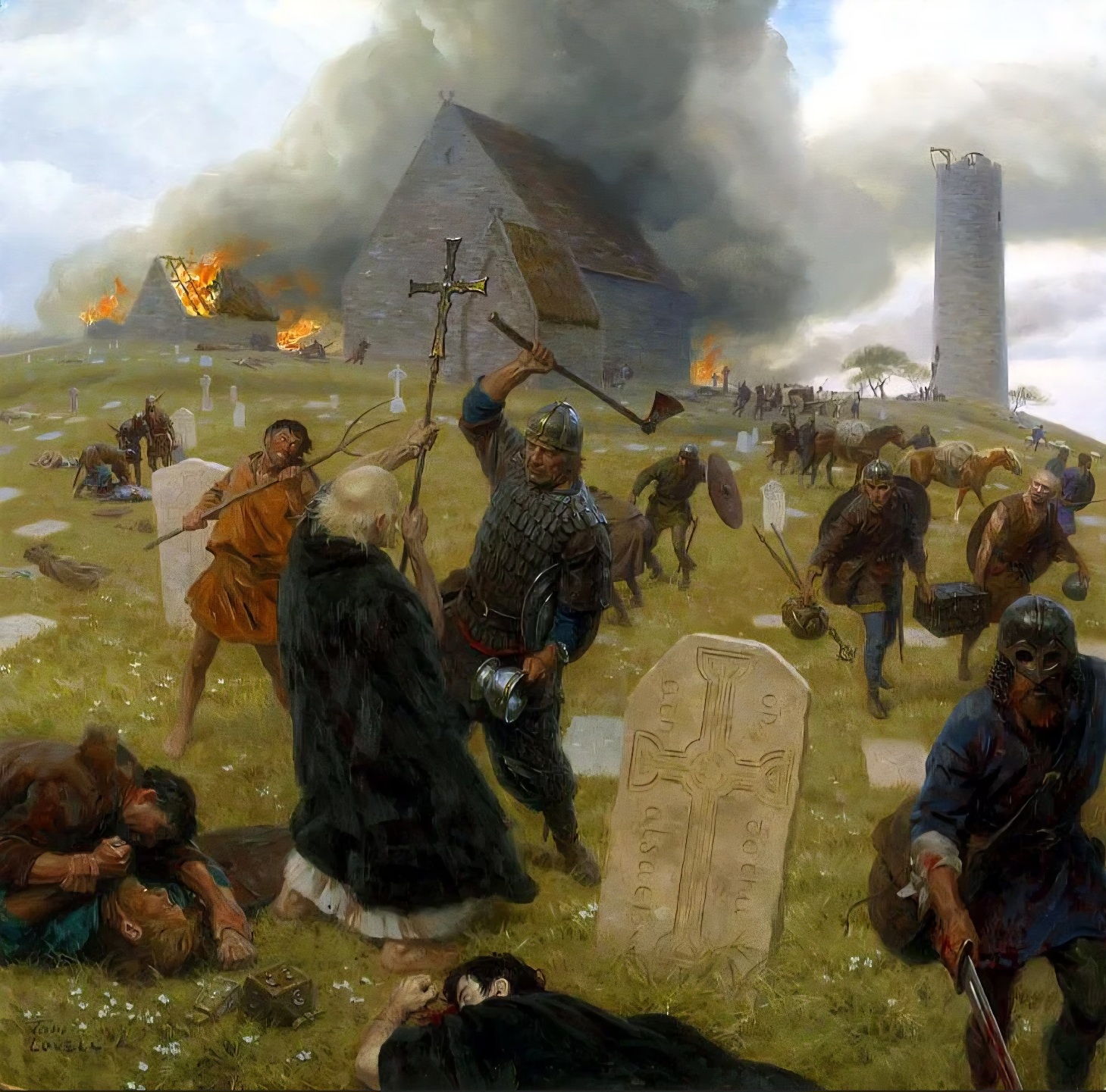
When the Viking longships arrived from Norway, they exploited this vulnerability perfectly. The Norsemen were polytheists who did not fear Christian damnation or respect the sanctity of the church. They viewed the monastery simply as an unprotected storehouse of immense wealth. The contemporary Anglo-Saxon Chronicle records the horror of the event, noting that the raiders “miserably destroyed God’s church on Lindisfarne, with plunder and slaughter.” Monks were hacked down in the cloisters, drowned in the sea, or shackled and carried away into slavery. Altars were desecrated, and the monastery’s accumulated treasures were plundered.
The Intellectual and Religious Aftermath
The raid sent shockwaves throughout Christendom. In an age where religious faith dictated how people understood world events, the sack of such a holy place caused a profound existential crisis. Scholars and rulers struggled to understand why God would allow pagan raiders to destroy His sanctuary.
Alcuin of York, a prominent Anglo-Saxon scholar serving at the court of Emperor Charlemagne in Francia, wrote numerous letters lamenting the disaster. He famously remarked:
“Never before has such terror appeared in Britain as we have now suffered from a pagan race, nor was it thought that such an inroad from the sea could be made. Behold the church of St. Cuthbert spattered with the blood of the priests of God, despoiled of all its ornaments.”
Alcuin and other church leaders concluded that the raid must be a manifestation of divine wrath, punishing the Anglo-Saxon kingdoms for their perceived moral decay and sins.
Portents, Omens, and Internal Strife
According to the Anglo-Saxon Chronicle, the year 793 AD began with terrifying, supernatural omens that deeply unnerved the population of Northumbria. Chroniclers recorded immense flashes of lightning, violent whirlwinds, and visions of fiery dragons soaring across the night sky. These bizarre atmospheric phenomena were immediately followed by a severe famine, which church leaders interpreted as explicit spiritual warnings.
Modern historians point to severe internal political instability within Northumbria that left the coast exposed. Just five years prior, King Aelfwald of Northumbria was assassinated by a faction led by the nobleman Sicga. In a strange twist of fate, Sicga committed suicide in February of 793 AD and was buried at Lindisfarne just six weeks before the Viking ships appeared. Scholars like Alcuin viewed the desecration of the sanctuary as a direct holy vengeance on a kingdom stained by regicide and civil warfare.
The Surviving Legacy and the Domesday Stone
Remarkably, the Christian community at Lindisfarne did not vanish completely after the initial assault. Bishop Higbald survived the massacre and worked frantically to regroup. The enduring terror of the Scandinavian threat was etched in stone by the monks who remained, left behind on a famous ninth-century grave marker discovered centuries later, known as the Domesday Stone. One side of this dramatic limestone relief carving depicts a row of seven uniform, marching warriors brandishing distinct Scandinavian-style battle-axes and swords. This artifact stands as a rare, contemporary visual record of the physical trauma and constant dread felt by the Anglo-Saxons during this dangerous transitional period.
Dawn of the Viking Age
While sporadic coastal skirmishes had occurred prior to 793 AD—such as a minor clash in Portland around 789 AD the Sack of Lindisfarne is traditionally marked by historians as the official catalyst for the Viking Age.
The raid proved to the Scandinavian chieftains that the British Isles were wealthy, divided into competing kingdoms, and utterly unprepared for amphibious blitzkrieg tactics. This success triggered a paradigm shift. Over the next two and a half centuries, hit-and-run raids evolved into large-scale invasions, permanent settlements, and the establishment of the Danelaw in England. The geopolitical shockwaves originating from Lindisfarne on that June morning would continue to reshape the map, language, and culture of Europe until the definitive conclusion of the Viking Age at the Battle of Stamford Bridge in 1066 AD.
Clearing Misconceptions: The Spiritual Heart of Norse Tradition