Hospitality in the Old Lore: Part 3
This is the third piece in a short series. If you are new here, start with Heathen Hospitality and the Guest in the Hávamál, which covers the host, then read A Gift for a Gift: The Guest’s Duties in the Hávamál, which covers the guest.
Eight nights. That is how long a stranger in a blue cloak sat between two fires in a king’s hall, with no food and nothing to drink, while the man who should have welcomed him watched him suffer. The stranger was Odin. The king did not live to see the ninth night.
In the last two posts we looked at what the Hávamál asks of the host and what it asks of the guest. Those were the rules. This time we look at what happens when somebody breaks them. The old poems are full of feasts and welcomes, but two stories stand out as warnings: the fall of King Geirröð in the Grímnismál, and Loki’s wrecking of Ægir’s feast in the Lokasenna. One is a host who fails. The other is a guest who fails. Between them they show why our ancestors treated the open door as something close to sacred.
The King Who Starved a Stranger
The prose that opens the Grímnismál tells of two brothers, Agnar and Geirröð, who were fostered as boys by Odin and Frigg. Geirröð grew up to become a king. One day Odin and Frigg looked out over the worlds, and Odin bragged about how well his foster son had done. Frigg answered that Geirröð was so stingy with food that he tortured guests if he thought too many had come. Odin called that a lie, and the two made a wager on it.
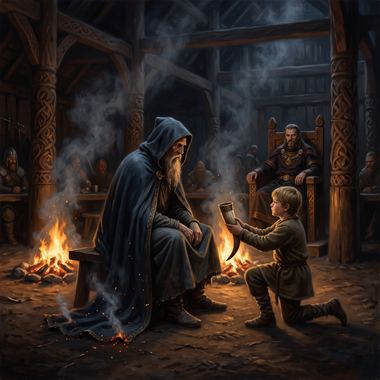
Frigg sent her handmaid Fulla ahead to warn the king that a sorcerer was coming to bewitch him, and that he would know the man because no dog would attack him. So when Odin arrived in a dark blue cloak, giving his name as Grímnir and saying nothing else, the king had him seized. When the stranger would not explain himself, Geirröð had him set between two fires and left him there for eight nights.
It is worth noticing how the story is built. Frigg’s warning was a trick, but Geirröð did not have to fall for it. A good host could have fed the man and kept an eye on him. Instead the king chose fear and cruelty, and in doing it he became exactly the man Frigg had said he was. The test was not whether a trap was set. It was what he did when the stranger stood at his door.
A Boy With a Horn
Not everyone in that hall forgot the old law. The king had a son, named Agnar after his uncle, who was ten years old. The boy went to the stranger, gave him a full horn to drink, and told him the king was wrong to torment a man who had done nothing.
That one horn of drink changed everything. As the fire crept up and began to burn his cloak, Odin spoke the long poem that gives the Grímnismál its name, full of the halls of the gods and the shape of the worlds. He blessed the boy and promised him a reward. At the end he revealed who he was. Geirröð jumped up to pull him out of the fire, his sword slipped from his hand, and he fell on the blade and died. Odin vanished, and Agnar ruled as king for a long time after.
The king had a whole hall and gave nothing. The boy had one horn and gave it. The gods remembered which one acted like a host.
This lines up with what the Hávamál says about the gift. It does not have to be big. A shared cup can win a friend. Agnar did not have the power to free the stranger, so he did what he could, and that was enough.
The Guest Who Poisoned the Feast
Now turn it around. In the Lokasenna, the sea giant Ægir brews ale and holds a feast for the gods in his hall. The prose tells us that hall was a place of great peace, where no one was to do violence. Ægir’s two servants, Fimafeng and Eldir, were so quick and good at their work that the guests praised them.
Loki could not stand to hear it, and he killed Fimafeng. The gods drove him out into the woods. But he came back, pushed his way in, and asked for a drink. When Bragi tried to refuse him, Loki reminded Odin of the oath they had sworn long ago as blood brothers, that Odin would never drink unless Loki was served too. Odin kept his word and had his son Vidar stand up to give Loki a seat.
What followed was a night of insults. Loki went down the benches one god and goddess at a time, mocking each of them in front of the rest. He only left when Thor came home and threatened him with his hammer. On his way out, Loki cursed his host, saying Ægir would never brew ale again and that fire would sweep over his hall.
The prose at the end goes on to tell of Loki’s binding, though the translator Henry Adams Bellows points out that the compiler probably tied that punishment to the wrong story. Either way the message is plain. A guest who brings violence and spite to the table does not just shame himself. He breaks the frith of the whole hall.
Oaths Still Hold, Even for a Bad Guest
There is a quieter lesson tucked into the Lokasenna that is easy to miss. Odin did not want Loki at that table. Loki had just killed a man in a hall of peace. But Odin had given his word, so he made room. Vidar, the silent god, got up and gave away his own seat.
That tells us something about how seriously the old ways took an oath. Keeping your word is easy when the other man is behaving. It means something when he is not. We wrote about this in The Hearth, the Anvil, and the Oath, and this story is one of the clearest examples of it in the lore. Odin held to his side of the bargain. It was Loki who threw the whole thing away.
What the Two Stories Teach Together
Put side by side, the lessons are simple:
- A host is judged by how he treats a stranger, not a friend. Geirröð failed with a man he did not know.
- Suspicion is no excuse for cruelty. The king had a warning, but what he did with it was his own choice.
- Small kindness counts. One horn of drink from a child outweighed a king’s whole hall.
- A guest can break the peace as surely as a host. Loki’s spite turned a feast into a curse.
- Your word holds even when others fail. Odin and Vidar kept the oath when Loki gave them every reason not to.
At Our Own Tables
Most of us will never sit between two fires or face down a god at dinner. But the holidays are coming, and with them come full houses, long tables, and people we do not always get along with. The old stories still have something to say about that.
If you are hosting, watch how you treat the person you know least. The quiet cousin, the new boyfriend, the coworker who had nowhere else to go. That is where your welcome gets tested. If you are a guest, leave the old arguments at the door. You do not have to like everyone at the table, but you are not there to tear the hall down.
And if you see someone being left out, you do not need to be the head of the house to fix it. Be Agnar. Fill a cup and hand it over. That is how frith gets built, one small act at a time, and it is why hospitality has always been a mark of true character.
Sources
- Grímnismál, Henry Adams Bellows translation (sacred-texts.com)
- Lokasenna, Henry Adams Bellows translation (sacred-texts.com)
- Grímnismál (overview and background)
- Lokasenna (overview and background)
- The Poetic Edda, Bellows translation (Project Gutenberg)
Read the whole series:
Part 1: Heathen Hospitality and the Guest in the Hávamál
Part 2: A Gift for a Gift: The Guest’s Duties in the Hávamál
Part 3: When the Welcome Breaks (you are here)