Yule in the Old Lore: Part 1
This is the start of a new series for the darkest weeks of the year. We wrapped up our look at hospitality with When the Welcome Breaks. Now we turn to Yule: what the old sources actually say about it, and how we can keep it today.
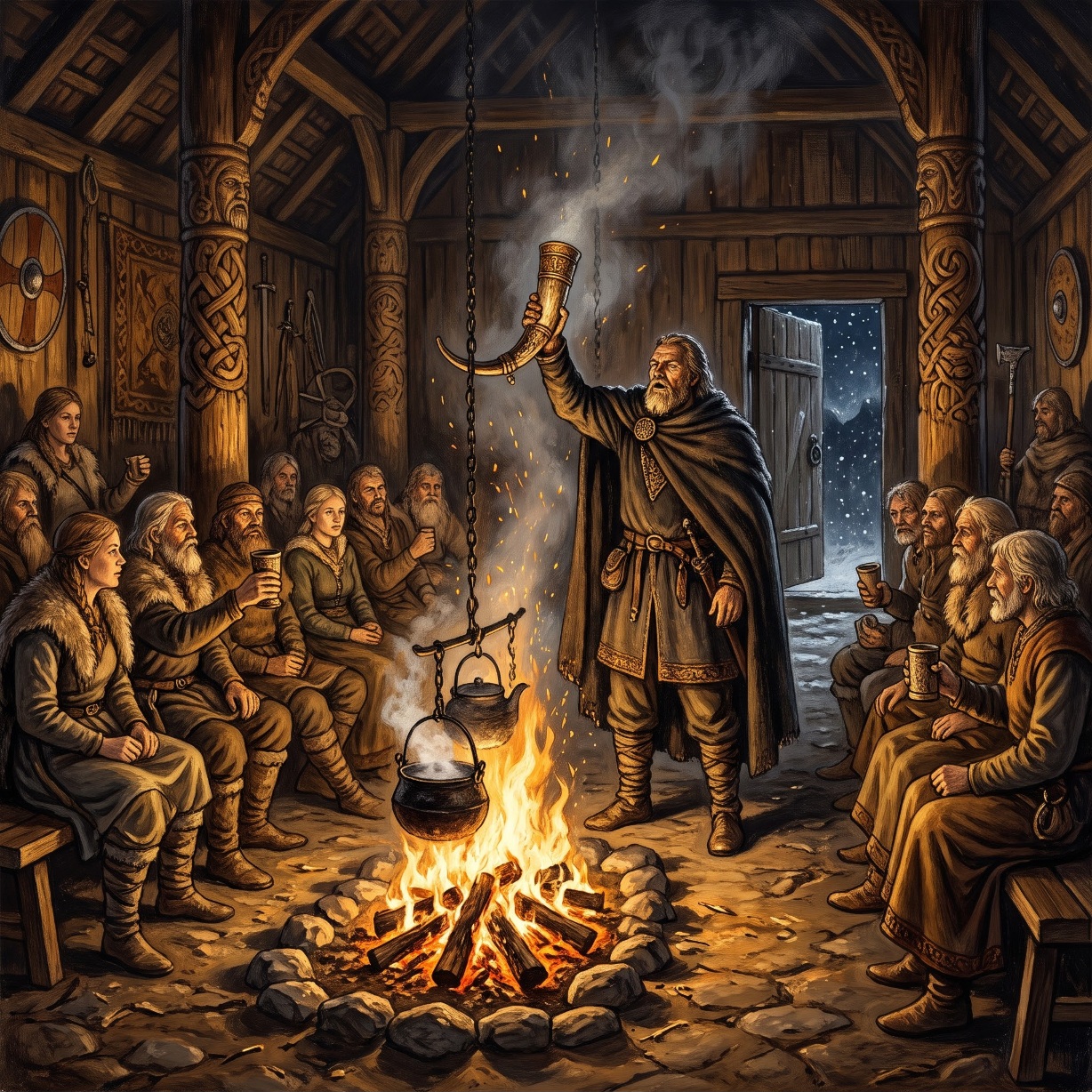
A fire burns down the middle of a long temple floor. Kettles of meat hang over it. A chief stands, blesses a full horn, and passes it across the flames. The first drink goes to Odin, for victory. The next goes to the gods of the harvest, for good seasons and peace. Then the horn goes around again, and men stand up to swear what they will do in the coming year. Last of all, they drink to the dead.
That scene is not made up. It comes from a saga written down in Iceland in the 1200s, and it is one of the best pictures we have of how our ancestors kept their great feasts. With the nights getting longer and Yule on the way, it is a good time to go back to the sources and see what they really tell us.
A Christian King and a Heathen Feast
Most of what we know about Yule in Norway comes from Snorri Sturluson’s Heimskringla, his history of the Norse kings, and in particular from the saga of Hakon the Good. Hakon was a son of Harald Fairhair who had been raised in England at the court of King Athelstan. He came home a Christian to a country that was still heathen.
Snorri says Hakon was smart enough not to force the issue at first. He kept his faith quietly. But he did make one change that matters a great deal to anyone curious about Yule. He passed a law that Yule should begin at the same time Christians kept their midwinter holy days, and that every man had to brew a set measure of malt into ale and keep the feast holy for as long as it lasted, or pay a fine.
In the same passage Snorri tells us how things were before Hakon. Yule used to start on a night called hökunótt, a midwinter night, and it was kept for three nights. Scholars still argue over what that name means and which night it fell on. What we can say is that the old Yule was tied to midwinter, it ran over several nights, and ale was at the center of it. Even a Christian king did not dare take the brewing away. He just moved the date.
The Feast at Hlader
A few chapters later Snorri describes how the great sacrifice feasts were held in the Trondheim country, where Earl Sigurd of Hlader ran them on the king’s behalf. The farmers came to the temple and brought food and drink to last the whole festival.
Cattle and horses were slaughtered. The blood, called hlaut, was caught in bowls and sprinkled with twigs over the altars, the walls, and the people. The meat was boiled in the kettles over the fire and shared out as a meal. Then the horns came around in a set order:
- Odin’s full, drunk for victory and power for the king.
- Njord’s and Frey’s full, for a good year and peace. The Old Norse phrase is til árs ok friðar. Some older English translations print Freyja here, but the Norse text names Frey.
- The bragafull, the chieftain’s cup, which many drank and swore vows over.
- The minni, the memory cups, drunk to kinsmen who had died.
Earl Sigurd paid for the whole feast himself, and Snorri makes a point of praising him for it. That fits everything we covered in the hospitality series. The man who held the feast was judged by how well he fed the hall.
The Sign of the Hammer
There is a great moment in the next part of the saga. At a later sacrifice feast at Hlader, held as winter came on, the farmers pushed King Hakon to sit in the high seat instead of eating apart like he usually did. Earl Sigurd blessed the first horn in Odin’s name and handed it to the king. Hakon drank, but first he made the sign of the cross over it.
A farmer named Kár of Gryting spoke up and asked why the king was doing that. Sigurd answered fast. The king, he said, was doing what anyone does who trusts in his own strength. He was blessing the cup in Thor’s name by making the sign of the hammer over it. That settled the room for the night.
It did not settle things for long. The next day the farmers pressed Hakon to eat horse meat from the sacrifice, and it took all of Sigurd’s skill to keep the peace. But the story shows two things. First, the hammer sign over a cup was something the people knew and expected. Second, a good man in a hard spot can hold a hall together with a few calm words. Sigurd kept frith between a king and his people when it could easily have turned to blood.
The horn went around in order: the gods, the year ahead, our own oaths, and then the dead. Nobody at the table was forgotten.
Yule Among the English: Mothers’ Night
Norway is not the only place we hear about Yule. Writing in England around the year 725, the monk Bede set down what he knew of the old English calendar in his book The Reckoning of Time. He said the heathen English began their year on the night we now call Christmas Eve, and that they called it Modranecht, which he translated as “mothers’ night.” He guessed the name came from rites they held all through that night.
Bede also said the months around midwinter were called Giuli, the same word as Yule, named for the time when the sun turns back and the days start to grow again. Bede is the only writer who mentions Mothers’ Night, so we cannot say much more about it than he did. But it lines up well with older carved stones from the Rhine country dedicated to groups of divine mothers, and it reminds us that Yule was a family feast as much as a temple feast. We will come back to Mothers’ Night in the next part of this series.
One more thing. One of Odin’s many names in the old poetry is Jólnir, often read as “the Yule one.” The god of the first horn at Hlader is also, by name, the lord of the season.
Keeping Yule Today
We do not live in the Trondheim country, and most of us are not slaughtering horses in December. But the bones of the old feast are easy to keep, and they work whether you are alone or with a full kindred:
- Keep more than one night. The old Yule ran for three nights at least. Spread it out so it is a season, not a single dinner.
- Brew or buy something worth sharing. Hakon’s law said every household had ale for Yule. Mead, ale, cider, or something without alcohol, it should be good and there should be enough.
- Drink the horns in the old order. First to Odin, then to Njord and Frey for a good year and peace. Then oaths, then the dead. Our Sigrblót post walks through a simple blot and sumbel you can adapt.
- Swear something you will actually do. An oath at Yule is not a New Year’s wish. It is a promise made in front of the gods and your people. We wrote about that weight in The Hearth, the Anvil, and the Oath.
- Say the names of your dead. The minni cup is the heart of it. Say who they were and what they gave you.
Most of all, open the door. The feast at Hlader worked because one man paid for it and everyone came. If you know someone who will be alone this Yule, that is your first guest. The old ways have always been about the hearth and the people around it, and the darkest nights of the year are when that matters most.
Sources
- Heimskringla, Saga of Hakon the Good: Hakon Spreads Christianity (Laing translation)
- Heimskringla, Saga of Hakon the Good: the sacrifice feasts at Hlader (Laing translation)
- Heimskringla, Saga of Hakon the Good: King Hakon Offers Sacrifices (Laing translation)
- Yule (overview and history)
- Módraniht, Mothers’ Night (overview)
- Hakon the Good (background)
Yule in the Old Lore:
Part 1: Three Nights and a Full Horn (you are here)
Part 2: Mothers’ Night: The Women Who Watch Over the Kin (coming November 24)
Part 3: The Boar and the Yule Vow (coming soon)